

Beyond Odette, Tino and Uwan: how mangroves protect Siargao’s residents

SIARGAO, Surigao del Norte (MindaNews / 14 December) — In the two and a half hour sea journey from Surigao City to Siargao, what greets the visitors first are traces of a dark green wall sticking out from the waves of the Dapa Channel. Closer to the shore, one sees knotted branches and tangled roots of siargaw (mangroves) forming a scaffolding varnished by seawater.
Siargao, the name of the world-famous tourist destination, traces its roots within these mangrove forests: “siargaw” or “saliargaw” (Premna odorata), a mangrove species that defines the island’s identity before its more known moniker as the “Surfing Capital of the Philippines.” This teardrop-shaped island in Surigao del Norte has captured the imagination of travelers worldwide, lured by what many refer to as an enchanting “curse.”
The island is home to 132,000 residents (as of the 2020 survey) in nine towns — Burgos, Dapa, Del Carmen, General Luna, San Benito, Pilar, San Isidro, Santa Monica, and Socorro.

In Del Carmen, Mayor Alfredo M. Coro II walks down the Mangrove Boardwalk, a 1.8 kilometer elevated concrete platform that snakes through the heart of the vast mangrove forests of Del Carmen town, the largest contiguous mangrove ecosystem in the Philippines.
“Before, life here was extremely difficult,” he recalls.
When he first assumed office in 2010, he was confronted with stories of fisherfolk forced to sell their organs to survive, and children eating sand just to ease their hunger. The community endured typhoons that struck the island nearly four months each year.
“All kinds of illegal activities could be found here. That was the time we had piles of mangrove barks. That’s how difficult life was for us,” the mayor shares.
A few meters from the entrance of the Boardwalk is a collection of houses propped up from the waters of Del Carmen. Junrey Longos, a fisherman who began as one of the many who cut mangroves illegally, narrates how their livelihood here, “ever since I was old enough, has always depended solely on the mangroves.”

At age 10, Longos followed in his father’s footsteps, venturing into mangrove cutting. Back then, they could slip away unnoticed, carrying bundles of mangrove bark through the forests. The cuttings were used primarily for firewood, a trade that would earn them at least one thousand pesos a day.
In 2010, Del Carmen recorded a poverty incidence of 69.9%, with malnutrition rate among children reaching 26.1%.
“We couldn’t just take away their livelihoods, especially for those involved in illegal activities, without offering an alternative,” Coro explains.
Longos now works as a boat operator and Bantay Dagat watchman for the Department of Environment and Natural Resources, supporting a family with children heading to college.
Rising Tide
About 16 kilometers away from Del Carmen lies one of Siargao’s now-popular stops, the Litik Maasin River in Pilar town, famous for its distinctive coconut tree rope swing that hangs above its clear waters.
Jerome Miranday, a tour guide born and raised nearby, remembers a different river from his youth. “We came here to bathe, and we also fished. The river is rich with crabs, shrimp, and lukon (tiger prawns),” he says, nodding toward the glinting water.
Amid the steady stream of tourists entering the Litik Maasin River stands a small souvenir shop tended by Margin Sulapas and her sister-in-law, Glory. Both share fond memories of the river.
“Right Gin? Back then on Saturdays or Sundays, we would make plans to go fishing?” Glory reminisces.
“That’s also where we bathed, did our laundry, and fetched water to wash dishes and pots because it was clean,” Gin responds.
Before the river gained recognition beyond the community, it was a playground for children. They would tie ropes to the trees and swing, turning the area into their own hidden haven. As Gin remembers, a foreign visitor happened to cross the bridge and was drawn to the sight of the children at play. Capturing the moment, the visitor took photos and later shared them online.
That moment marked the spark of tourism in the area, a turning point that opened doors for the residents to shape livelihoods from their own skills and knowledge.

Miranday fondly remembers how the Litik Maasin River tour blossomed into a true community endeavor: every guide, every helper, hails from the same barangay, bound by a sense of local pride.
What began with just two or three small boats slowly grew over time. That humble effort transformed into a vibrant enterprise, with dozens of fiber-made boats gliding along the river ready to share the magic of their home with every visitor.
There are now 150 tour guides, with almost every household having at least one. Some work as boat operators, others handle maintenance, while still others take on roles as vendors, photographers, lifeguards, or even drone operators.
The same is true with Glory and Margin. In earlier years, survival often meant gathering shellfish beneath the mangroves or planting and harvesting sweet potatoes.
“We can buy things now, things we couldn’t afford before. We can cover our daily needs, even food,” Gin says.
Tourism transformed Siargao from a quiet island to a viral global destination. Surfboards, sun hats, and bright tourist smiles filled the beaches.
In General Luna, the most famous among the nine towns, the Municipal Tourism Office recorded a steady rise in tourists from just 28,715 visitors in 2015 to over half a million – 538,397 – in 2024.
Yet with this influx of visitors comes an unmistakable challenge to balance opportunity and responsibility.
“Siargao curse”
Six years ago, Sofia Nicole De Asis moved here with her son from Lapu-Lapu City in Cebu where she was working as a Project Associate for an overseas data company.
She jokingly attributed her move to the “Siargao curse.
“Siargao curse” is a playful nickname coined by its visitors about the enchanting charm of the island, that once you arrive, you’ll never want to leave.
She smiles, remembering, “The island and its people are so welcoming that it feels like you are included in the community.”
That sense of connection became the seed for Project Paradise Community, her locally led initiative focused on education, health, and environmental advocacy. Still, Siargao faces challenges that go beyond access to education.
“One of the major problems that I saw that is impacting environment related to overtourism is the amount of waste that is being thrown in the beaches” De Asis says. Overtourism means there are too many visitors to a particular destination.
Without clear guidance, many tourists were unaware of the cultural and environmental responsibilities expected of them. This gap inspired local advocates to launch initiatives centered on cultural education.
De Asis points to Lady Carmel Litang, leader of Siargao Environmental Awareness (SEA) Movement, as an example of local advocacy in action. “Miss Lady has been an advocate for environment and she would stand there and she would say, ‘We have sea turtles here. What are we supposed to do?’”
Litang has witnessed firsthand the consequences of inattention. “I can really say that there are irresponsible tourists, and even some locals, not all, but some who don’t even care. They just throw their trash anywhere and leave it behind,” she adds.

Managing the waste stream is an ongoing challenge. According to General Luna’s Solid Waste Management Baseline Assessment Results in 2024, food waste makes up 38% of what’s thrown away, followed by cardboard (8%) and garden waste (8%). Among plastics, PET bottles (6%) and single-use sachets (6%) are the main contributors. Of the 1,036 tons of plastic generated yearly, 63% is properly collected but 32% remains unmanaged, often ending up in waterways, landfills, or burned.
In Siargao, every visitor carries the potential for impact, be it positive or negative. The island’s challenge, and its opportunity, is to ensure that growth lifts all boats without capsizing the environment or the people who call it home.
Odette’s Wake
On December 16, 2021, at exactly 1:30 PM, Typhoon Odette (Rai), a Category 5 supertyphoon, made landfall on Siargao. Waves crashed over the shores, winds tore through homes, and the island seemed to hold its breath.
“In Del Carmen, around 95% of our properties were damaged. Buildings, homes, livelihoods: everything was destroyed, nothing was left,” recounts Mayor Coro, the memory still vivid for him.
Among them was Eutiquio “Titing” Botona Flores, the municipality’s first recognized local hero. He was posthumously awarded the title on February 3, 2022 for saving the lives of more than a hundred children in Barangay Lobogon.
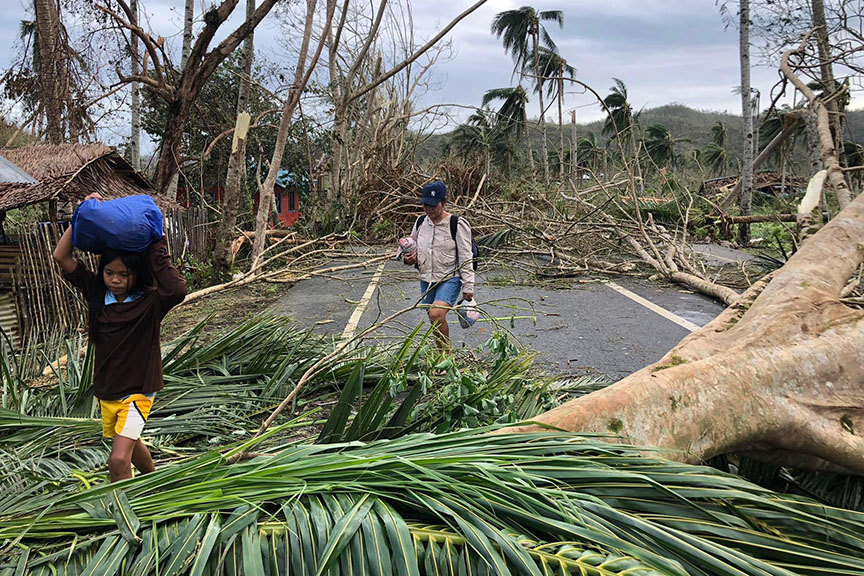
Despite the scale of destruction, the human toll was miraculously low. Of Del Carmen’s 24,000 residents, only three died.
“On the last attempt to save one more life, he lent his motorcycle helmet.” Botona was then hit by flying debris, Mayor Coro recalls.
Families braved the storm in evacuation centers. Longos remembers sheltering with his family in Del Carmen’s gymnasium, only to be forced to flee when the structure gave way. “When the floodwaters rose, we just had to swim there,” he says, gesturing that the water almost reached his hips.
Two days later, the mayor, accompanied by a priest, ventured to Barangay Halian, a flat island vulnerable to every element with nowhere to run. Boats refused to carry them. “I brought water. Then the story came out that we supposedly brought a lot of holy water because it seemed like we were going to hold a mass burial there,” added Coro.
When they arrived, not a single life was lost.
The devastation brought by Typhoon Odette became the turning point. In its aftermath, De Asis and her team were among the first to reach the remote island of Halian, delivering urgent relief to residents who had been cut off from aid.
Protected by mangroves
Mayor Coro attributes the decreased devastation and loss of life to the mangroves surrounding the area. “They saw how our mangroves stopped the wave energy,” he explains.
Mangroves quietly store massive amounts of carbon in their roots and submerged soils, providing a natural defense against carbon dioxide, one of the main drivers of climate change. This storage, known as “blue carbon,” can be quantified and sold as carbon credits to offset corporate greenhouse gas emissions, with the proceeds funding further conservation efforts.
Del Carmen positioned itself early in this field. In 2018, the local government adopted a Sangguniang Bayan Resolution recommending the creation of the Blue Carbon Technical Working Group (BCTWG). The municipality claims to be the first local government to localize the development and implementation of the Blue Carbon Ecosystem and Resiliency Approach.

Longos, once an illegal mangrove cutter, now understands the mangroves’ true value. “If not for the mangroves, all the houses here would have been swept away,” he says.
By February 2022, Sayak Airport in Del Carmen reopened, allowing commercial flights and relief operations to start in earnest. “Let them come, let them understand what we’re going through, let them experience it with us, and hopefully, they will also try to stay with us and witness our recovery,” says the mayor.
Locals like Glory and Margin Sulapas near Litik Maasin noticed the impact of community support firsthand. “We’re thankful to the tourists who came. They could relate to what we’ve been through,” Glory says.
De Asis highlights the “collaborative feeling” she observed in the aftermath. Even amidst scarcity, neighbors shared food and shelter. She remembers how neighbors would ask: “Do you still have rice there? Are you sure you still have rice? I still have rice here?”
Remarkably, despite the COVID-19 pandemic then, Siargao recovered in less than six months. The island’s goodwill, forged over decades, became a cornerstone of resilience.
“This is Siargao. Many people had a good time here, so they also experienced what happened. They wanted to help out,” says the mayor.
Second Wind
Odette left an indelible mark on Siargao. And the mangroves rooted here were witness to it all.
In the first week of November 2025, the island was once again tested as the successive winds of Typhoon Tino (Kalmaegi) and Uwan (Fung-wong) brought intense gusts and rough seas.
The municipalities of General Luna and Del Carmen quickly mobilized, posting updates on their official Facebook pages and rolling out immediate relief and early recovery efforts to restore normalcy for their communities. No casualties were recorded in the affected areas.
Longos, who now works as boat operator and Bantay Dagat watchman, admits that it wasn’t easy to stop cutting the mangroves for profit but “if I hadn’t, I could’ve ended up in jail. It could’ve affected my children’s education. So we stopped.”
The shift from survival to sustainability has been deliberate. After placing health at the top of his priorities, Coro turned the local government’s attention to education, emphasizing programs that instill individual discipline, environmental responsibility, and protection.
“We’re doing a lot of these programs so that we can really target all of our demographics,” Coro says.
Some initiatives take unconventional forms. Rave parties, for instance, have been used to promote mangrove conservation in ways that resonate with younger audiences. Traditional forums often fail to capture the attention of millennials and Gen Alpha, Coro explains, so campaigns must meet them where they are.

The ban on single-use plastics was also strictly enforced. “The mayor really implemented the rule that we should no longer use plastic, because once we’re caught, we will be fined,” says vendor Margin.
Pilar town, where she tends to her souvenir shop, is the first town in Surigao del Norte to implement a ban on single-use plastic bags back in February 2018.
“The mayor really implemented the rule that we should no longer use plastic, because once we’re caught, we will be fined,” she adds.
“Everybody has a vital role”
Community-led organizations like Project Paradise Community and the Siargao Environmental Awareness (SEA) Movement have become essential partners. Through coastal clean-ups and workshops, locals are actively involved in protecting their home.
De Asis of Project Paradise Community underscores the importance of collective responsibility. “Everybody has a vital role in the community. And in order for the community to work and strive, everybody needs to participate, not only us, but also the local community. They need to have the willingness to be involved,” she explains.
“We’ve fallen so many times we could not count, but we continuously tried to stand up together,” the mayor says.

That resilience became the foundation of Del Carmen’s identity. The branching leaves of mangroves tighten inward, embracing the land and the people in it. Their dark green wall remains a bulwark.
Enjoy its waves, its attractions, its charm. And when the time comes you are “cursed” to stay in Siargao, its open-armed blessing will be yours, so long as you embrace it in return.
(Benjamin Caspillo III with reports from Kisha Mica Bardago / MindaNews. The production of this report was made possible with support from the Canada Fund for Local Initiatives)

No comments:
Post a Comment