

Battered by Sendong, spared by Basyang: how a flood control project could save lives and properties

ILIGAN CITY (MindaNews / 10 February) — Residents of Orchid Homes, a subdivision with over 300 houses by the mouth of Mandulog River that was one of the most badly hit areas during Typhoon Sendong in 2011, did not have a good night’s sleep when Tropical Storm Basyang swept across Iligan late evening of February 5 until the early hours of February 6.
It brought them back to those horrifying hours 14 years ago — also late evening, on December 16, 2011 until the early hours of December 17 — when Typhoon Sendong unleashed its fury.
But what a relief it was when no flood waters entered their homes, not even their streets even as the PAGASA weather bureau reported that Basyang unleashed much more rainfall than Sendong, maybe even double.
So, what happened?

Residents say the flood control project worked but hope government addresses the gaps in the project to save more lives and properties.
Christmas party
Couples Michael and Ana Emano and Ronald and Gina Buena Magno were attending the same Christmas gathering of the Department of Education on December 16, 2011. Michael and Ana Emanoa are both working for DepEd, Michael already a principal of an elementary school by then. Gina Magno was among 10 most outstanding public school teachers in the city.
It was already raining when they separately went back to their respective homes late in the night within the same subdivision in Barangay Santiago. But Iliganons — and Mindanawons in general, maybe except those living in the Surigao area, didn’t really know what typhoons looked like. “Typhoon-free” was a claim Mindanawons could be proud of then as it was the lone island grouping generally spared by typhoons, unlike Luzon and the Visayas.
Both couples shared nightmarish experiences when Sendong came, something they will never forget in their lifetimes.
Because they got wet in the rain, Michael showered and was waiting for his hair to dry when one of his teachers at school who was living closer to Mandulog River called.
“She asked if we’re leaving because water level was unusually high,” he told MindaNews on Monday. He went outside to check, he saw a little flooding, but there was no water on the road outside their house yet.
Waking up neighbors
When water finally came to his doorsteps, he woke up neighbors. “But only neighbors that I knew, neighbors who became friends. I didn’t bother waking those who won’t even bother saying ‘hi’ because I’m sure they’d get mad at me if no flood happened,” Michael said.
He even threw a stone at a doctor friend’s house to make sure he’d wake up, and fortunately he did.
On his way back home, Michael saw a young mother carrying her two kids. The current was strong, the flood already at knee level, so he carried one child and told the mother to hold on to him.
Upon reaching home, Ana was already shouting in fear.

“I called friends with cars to please rescue us,” Michael recalled. The closest one responded and rushed toward Orchid Homes, but could not anymore enter the subdivision. He parked and waited for Michael and his family — his wife, both his in-laws, and his 6-year-old and 7-month-old children.
“My in-laws said that had we not come home by then, they would just climb up the double-deck [bed],” Michael said, showing a picture of a slipper stuck on the ceiling because of the flood.
Lost everything
They left bringing nothing. Not their diplomas and other important documents, not their laptops, not his motorcycle because water was already waist deep. Not even their dog Friday and their cat Tomas. (They later found Tomas, but not Friday.)
The Magnos were not as lucky — they were not able to leave. In the case of Sendong, thousands of logs, many of which were illegally cut or uprooted by the typhoon, flowed down Mandulog River, then got trapped at a bridge almost two kilometers upstream from Orchid Homes. It acted like a dam as more logs came, and water gradually rose on both sides of the river.
The bridge was apparently not designed to handle the load of thousands of logs constantly pummeling its foundation. When it finally collapsed, it released tons upon tons of water downstream, causing a flashflood that gave residents of Orchid Homes and adjacent areas only a few minutes to react.
“The water rose so fast, from knee level to the waist in a matter of minutes, so I thought of nothing else but to save my family,” said Ronald, an engineer who works for the liquidator of the defunct National Steel Corporation.
Climbing the roof
Lucky that Ronald had a ladder at that time for some construction work, allowing him to lead his wife and his teenaged twin sons atop the roof (the eldest, a medical student at that time, was at a Christmas party and hadn’t come home by then). Then he helped a couple with a young child (his wife’s relatives) living nearby to the roof, too.
Across the road was a policeman, Roger Tabuniag, who could no longer cross the road to join them because of the strong current.
“I asked him if he had a rope so he can throw it to me and send him the ladder; he had none,” Ronald recalled.
He climbed down and looked for a rope amid the water, when power was out, and found a wire instead. He was thus able to send the ladder to the policeman.
“Just as they reached the roof, the rush of rampaging floodwaters came. Had they not climbed, they would have likely drowned,” Ronald said.
The water came with the logs, so many of them that for weeks, the logs lining up the shore of Barangay Santiago spanned maybe a kilometer long.
“I heard the explosions when the logs hit my neighbors’ houses. Boom, boom, boom!” Ronald recalled.
So God may hear
At the roof, they prayed and prayed.
“Everybody was praying so hard I even wanted to shout my prayers to make sure I could be heard by God,” Gina wrote in an online blog recounting the family’s ordeal.
Ronald, while sitting by the edge of the roof, let his feet hang, touching the water, so he could monitor if the flood was still rising or falling. The hours passed. It was already 4 a.m. when he sensed that water was receding.
They all survived Iligan’s worst disaster ever. But many of their neighbors did not. The Magnos decided to return to Orchid Homes after a few months of staying with relatives.
Ronald singlehandedly rebuilt their house, thanks to a high school education that was heavy on vocational courses, to the envy of neighbors who do carpentry and related work and were hoping to earn a few bucks amid the crisis.
“I can do welding, furniture and cabinet making, woodworking, electrical works,” he narrated the vocational courses he underwent at the Mindanao State University – Iligan Institute of Technology.
The Emanos, meanwhile, left the subdivision after Sendong, renting a house in Dalipuga close to where they both work. (Michael is principal of the Dalipuga Vista Village Elementary School.) They returned to Orchid Homes only in 2021.
Esplanade
“We came back when construction of the flood control project and esplanade was completed,” Michael said.
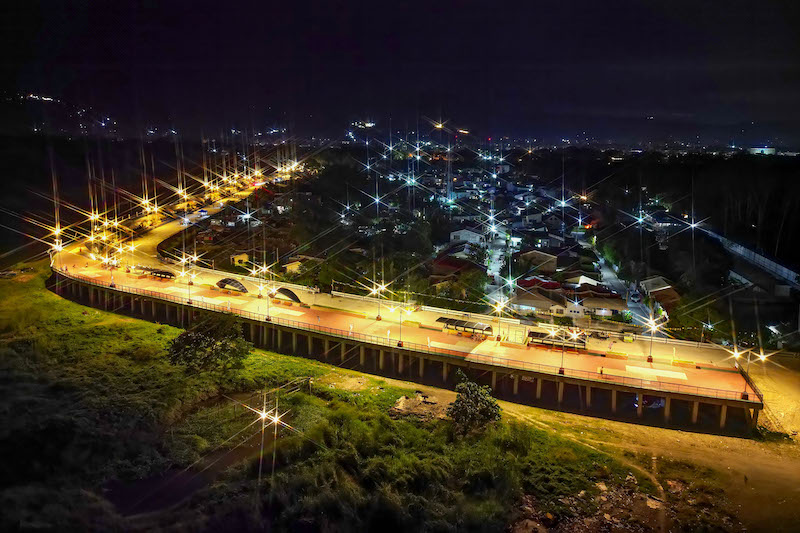
The Mandulog River Esplanade, which is about 500 meters long on the southwestern side of the river, was inaugurated in July 2021, in the middle of the COVID-19 pandemic. It is supposed to be Mindanao’s first ever river esplanade. It quickly became one of the favorite go-to places among Iliganons who are into walking, jogging, or those who just want to enjoy the scenery and the fresh air offered by the river and Iligan Bay.
It is part of a two-kilometer flood control project all the way to the highway to its east. It protects the entire length of the part of the Orchid Homes facing the riverbank, and more.
Could have been worse
“Had there been no flood control project when Basyang came, it could have been worse than Sendong,” Michael said, but was quick to add that he was talking about the floodwaters, because there was no deluge of logs during Basyang.
“When they built the riprap, and eventually the esplanade, that’s when we told ourselves that maybe we’re safer now,” said Ronald.
But still, they still stayed almost awake all night on February 5, their go-to bags ready should they need to evacuate to higher ground. Michael and his son Norain kept going back to the esplanade, about 150 meters away — at first walking, and later on a motorcycle — counting the steps still visible (and not covered by water) of its stairs being used by maintenance workers.
“Past 2 a.m. on February 6, there were only 10 steps remaining,” he recalls.
At that time, Mandulog River’s current was unusually strong compared to what Michael had observed in previous floods.
“The sound was violent. There were already waves like those you see in reels posted by seamen while in the ocean,” he said.
“The esplanade’s steel railings were already vibrating, maybe when it got hit by logs and whatever heavy objects carried by the water,” Michael added.
By 5 a.m., the number of steps visible became 11, to Michael’s delight. “Meaning, water had receded,” he said.
Another half hour, it became 12, then 13. At 6:05 a.m., he counted 15 steps. Only then did he heave a sigh of relief.
‘Minanok’
Ronald said he was restless all night: “minanok” as he describes it. Meaning, half asleep, half awake. More so because he was to report for work in the morning.
He monitored updates all night, and heard about the news that Tubod Bridge and Tambacan Bridge were no longer passable. Both bridges traverse Iligan’s other major river — Tubod River — which overflowed.
Before he left for work in the morning of February 6, he drove the Honda Civic owned by his son (a medical doctor practicing in neighboring Ozamiz City), which was left to him for safekeeping, to a relative’s house situated on higher ground. Then he told his wife to evacuate immediately if there would be any more sign of a flood.
“I don’t completely feel safe here, and I don’t plan to stay here forever,” he said.
He pointed out that the government has still classified still classifies Orchid Homes as “danger zone.”
The Emanos and the Magnos may have been spared by Basyang’s wrath, but not far from Orchid Homes, some houses were destroyed because there are still a few gaps in the flood control project.
Michael said some landowners blocked construction of the flood control project because they could not strike an agreement with the Department of Public Works and Highways (DPWH), maybe a road right of way issue.
“I hope these landowners won’t oppose construction because lives and properties are at stake here,” he said.
The unlucky ones
Among the unlucky residents living near the riverside with a gap in the dike are Jonathan Tabamo, 54, and Nestor Molit, 60, whose houses were washed away during Sendong because of the logs. They both built sturdier houses since then, which were inundated by floodwaters during Basyang.
Tabamo and family left to evacuate around 2 a.m. of February 6 to Tambo Central school, about a kilometer away, and later to the Adventist Medical Center nearby, where he and his wife are working.
Molit, whom MindaNews chanced upon by his yard washing a red sofa, hopes government finishes the flood control project.
“Had the gap been closed, water may still rise but not with a strong current,” he said. He and his family had to seek safety at the same school.
Both returned home in the morning February 6 to clean up, which they were still doing when MindaNews visited Purok 9 by the riverside in Sitio Bayug three days after the floods spawned by Basyang.
During his visit to Iligan on Tuesday to check on the damage in the aftermath of Basyang, Public Works Secretary Vince Dizon said they will have to address the gaps of the flood control projects in the city.
He promised that the DPWH central office will look for funding to close the gaps “because balewala ang flood control if may gap kasi doon papasok ang tubig.”
Mayor Frederick Siao pointed out too, that the esplanade project is not yet finished. (Bobby Timonera / MindaNews)

No comments:
Post a Comment