

Survivors mark Masara tragedy’s second anniversary with quiet remembrance

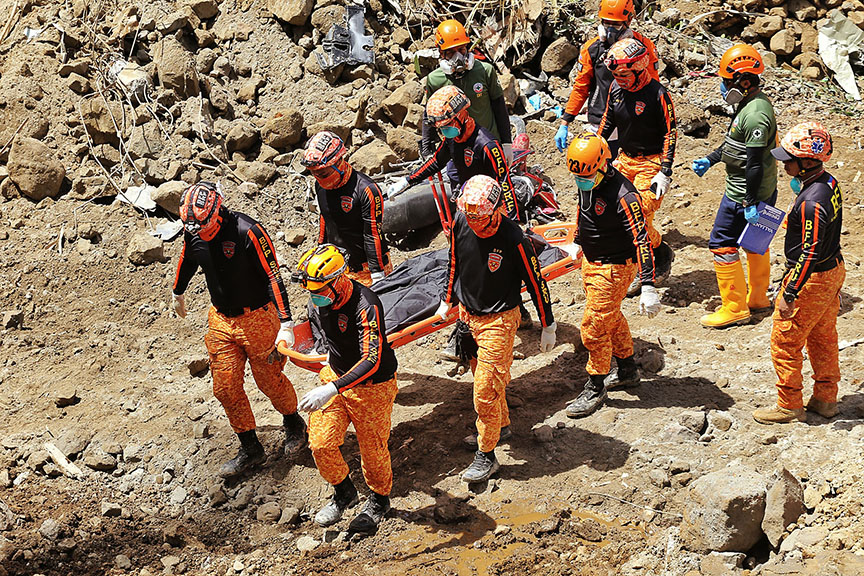
MACO, Davao de Oro (MindaNews / 7 February) – The second anniversary of the landslide in Barangay Masara in Maco town, Davao de Oro that killed almost a hundred and displaced thousands passed without any visible commemoration by local government units or national agencies.

This is a quiet shift from last year’s more public observance of the February 6, 2024 tragedy that some survivors said left them wondering.
For Xieanne Rosse Herda, also known in the community as Ate Inday and president of the association of residents in the new relocation site in Barangay Elizalde, the difference was noticeable.
“Mingaw man kaayo karon. Siguro kay last year fresh pa, pero bisan na uy, kay naa man to silay pa-misa sauna, salo-salo,” she said, recalling how the first anniversary was marked by a mass and a shared meal among survivors.
(It’s so quiet now. Maybe because it was still fresh last year, but that shouldn’t be a reason, because they had a mass and food-sharing then.)
Instead of stages and speeches, remembrance took place in small, private ways.
Some families lit candles inside their homes. Others offered prayers quietly, marking the day not with crowds, but with memory.
A candle for the lost
Among those who marked the day in his own way was Orlando Malacaste, 60, who lost his wife Liezel “Tata” Detomal, 37, and eldest daughter Shaira, 17, the night the landslide struck.

On Friday, Malacaste lit a candle in front of a small memorial wall beside the Mother of Perpetual Help chapel. What passes for a “memorial” was a tarpaulin attached to scraps of wood, listing only 78 of the 88 who perished.
The structure looked haphazard and unfinished, and the area was even faintly marked by the smell of urine.
But regardless of its state, Malacaste still chose to bend his knees before the list that includes his family.
He recounted the events of that night, still vivid in his mind. As the landslide roared down the slope, he cradled one of his daughters and found himself buried under rubble and mud for nearly an hour.
Everything happened so fast. The roar of rocks, the sudden collapse of the house, the chaos around him, that even now, Malacaste said, it still feels fresh.
“Liman ka, matiman-an pa gud nako unsa akong kahimtang paggawas. Mga usa ka oras nag sigeg kinamang sa lapok unya nagkasangit-sangit akong shorts sa lansang” he said, remembering the struggle and helplessness of trying to stay alive at that time.
(Imagine, I can still recall my situation after emerging from it. I crawled on mud for about an hour and my shorts got entangled with nails.)
Today, Malacaste continues to face the challenge of rebuilding life from the remnants of that night.
He has been awarded the 41st housing unit in the government relocation site in Barangay Elizalde, but has yet to fully move in as electricity has not been installed.
For now, he relies on the support of relatives to help care for his surviving daughters, ensuring they attend school and their daily routines are maintained.
A new place to begin again
Forty-one families displaced by the landslide have been awarded units in the government housing site in Barangay Elizalde after relocation began on December 8, 2024. Another 24 housing units are still set to be constructed.
According to Ate Inday, the relocation site brought some relief after months of uncertainty.
Each home has access to water and a septic tank system already, and residents only contribute P100 a month for the maintenance of the water system.
Electricity installation, however, was shouldered by each household.
While it is not the same life they had in Masara, it is safer ground.
Livelihood struggles, shared strength
In Masara, many survivors ran small stores that thrived on the steady flow of miners, workers, and passersby. Income was easier to come by.
In the relocation site, business is slower.
“Lisod jud karon. Sudlunon man ang pabahay, mao ang mupalit sa amo kay kami-kami ra pud,” Herda said.
(It’s really difficult now. The housing site is in the interior, that’s why the buyers are also just us.)
Still, residents have found ways to cope together.
Some women in the community make handmade rugs that they sell online, while others accept made-to-order work or take on small side jobs when available.
More than income, Herda said, it is also their shared support that keeps them going—sharing food, extending small help, and checking in on each other from time to time.
No activities at ground zero
Asked why there were no organized activities this year, Teresa Pacis, AVP for Corporate Affairs and Communication of Apex Mining, said that the company only followed the information from the Municipal Disaster Risk Reduction and Management Office (MDRRMO) of Maco.
“As relayed by MDRRMO-Maco, there will be no activities at Masara Ground Zero. This is also a precautionary measure in anticipation of Bagyong Basyang that will hit the province,” Pacis said in a message.
The landslide occurred near the company’s mining site. In a statement shortly after the tragedy, the Mines and Geosciences Bureau-XI said: “…A landslide incident occurred in the same area last September 6-7, 2008 due to heavy rainfall and deteriorating geophysical conditions. Since then, successive geohazard mapping and assessment were conducted by DENR-MGB-XI, results of which consistently show that the area is highly susceptible to landslides. Thus, the Department recommended the immediate relocation of the community of Brgy. Masara and for the area to be a ‘No Build Zone’.”
Two years after the landslide, grief ultimately remains, but the survivors in Barangay Elizalde continue to show the courage it takes to start again, together, on safer ground. (Allizah Keziah Manulat/MindaNews)

No comments:
Post a Comment