

Cooking binignit as an act of faith

KORONADAL CITY (MindaNews/3 April)–This is how Semana Santa looks like for Bisayâ Roman Catholics. The roads, though bare, lead to a clump of people in palengke cramming to find the ingredients to prepare the best binignit in the neighborhood.
Holy Week in the Philippines is often seen as a long rest from the usual grind but for the Catholic faithful, it is an opportunity to reflect on their faith and belief.
Semana Santa for the Roman Catholics means repentance in the form of confession, reconnection with God in the form of the 40-day preparation from Ash Wednesday to Holy Week, Visita Iglesia, and, sacrifice by abstaining from meat and finding meal alternatives that are acceptable for Holy Week.
In both times of sacrifice and abundance, Filipinos get creative with food. We don’t just prepare meals to fill our empty stomach. We create food that tells our stories of faith and brings people together.

On Maundy Thursdays, markets in the Visayas or Mindanao are already filled with ambulant vendors selling saging na sabá, kamote, úbe, gábi, and hinog na langkâ – all chopped up in small, bite-sized conveniences and individually packed in plastic. Shopping for ingredients here is akin to an artist trying to find the colors for a painting he envisions in his mind. In one corner of the palengke may be vendors selling colorful sago – red, green, and yellow –and the reddish landáng, the small, starchy irregular-sized balls sourced from buri palm trees. In another corner vendors may be selling coconuts which they offer to grate for an additional P10 to P15 a piece.
Chances are, neighbor Ante Inday might be waiting for her grated coconut there with hands akimbo. A prudent Bisayâ may remember the coconuts that fell on the backyard a few days ago and borrow a kagurán (kudkuran) from Manang Ising next door. It may save her a lot of money.
While there may be less people in the streets outside in respect to Semana Santa, the palengke is a different world teeming with people bargaining to get the best ingredients at the lowest prices. The mission is to bring home the complete ingredients for binignit, a sweet glutinous stew made of tubers, sago, saging sabá, and langkâ, in time for Good Friday.
Sometimes people refer to binignit as the hot version of the halo-halo as both are similar in color and ingredients. The nearest Tagalog version for binignit is the guinataang bilo-bilo although that version does not have the variety of ingredients like binignit.
Binignit is a Bisaya word that originated from Cebu City – bignit literally means chopping off or breaking into something smaller. But here in Mindanao, binignit has also made its place as a Semana Santa merienda. In Dipolog City and nearby municipalities, their version is called dinuldog – not to be confused with the other dinuldog which is guinataang kalabasa served also in Visayas and Mindanao. People in Cagayan de Oro City, Iligan City, and other neighboring areas call their binignit tabirak.
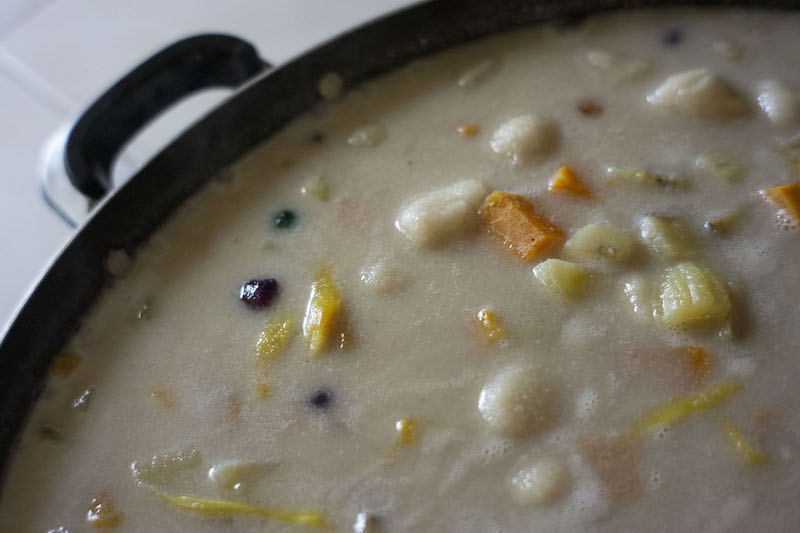
Back home from the palengke, we put the landáng in boiling water and wait for it to soften. Landáng not only lends a color unique to binignit but it also allows for a porridge-y consistency of the stew. We then put in the chopped sabá, kamote, gábi, and úbe.
People who have been preparing binignit for generations will tell you that it tastes better cooked over woodfire or charcoal instead of the modern stove. When cooking binignit, stirring must be continuous even when hands get sore and the skin hurt from the fire. It’s part of the Semana Santa sacrifice. The taste of the binignit will make it worth it.
Then, put in sago and langkâ mixing them well before putting in the pangalawang gatâ – the thicker coconut milk of the two gatâ batches. Bring it to a boil and then put in the little malagkit balls rolled earlier by hands like molding clay. Add the brown sugar, a pinch of salt to bring out the flavors, and the optional vanilla or pandan for added aroma. Mix them well and bring to a boil before adding unang gatâ.
Binignit is both sweet and filling – like a hug after a long day. It’s not luxurious nor extravagant. It supposedly empathizes with the suffering and death of Christ. The gathering of the ingredients up to the preparation of this meat-less dish are all part of the Semana Santa sacrifice.
Welcome the first bite by blowing onto the hot spoonful. Each spoonful a surprise – am I eating the chewy malagkit? Is this the kamote or úbe both sweetened by the porridge-y stew that has enveloped them? Or is this the strip of ripe langkâ that has been sweetened prior to boiling?
Binignit may be prepared by almost everyone in the neighborhood but it is also a cherished tradition to share with those who weren’t able to cook this year – but most especially to the likes of Manang Ising who lent us her kagurán. (Jennie P. Arado/MindaNews)
(Jennie P. Arado is a writer from Koronadal City, South Cotabato. She loves writing about local food intertwined with memories. Her children’s book Dako Nga Yahong Sang Batchoy was published by Aklat Alamid in 2021. Currently, she’s part of the South Cotabato-based group Timog Literary Circle. They organize poetry readings, book donation drives, writing workshops, and other literary events in the community.)

No comments:
Post a Comment