

MY MINDANEWS STORY | Beyond the byline: How my years at MindaNews shaped my writing

CAGAYAN DE ORO CITY (MindaNews / 18 May 2026) — The cursor blinks like a steady, mocking heartbeat on a darkened screen. In my 28-odd years in the publishing and news industry, this rhythmic pulse has been my most constant companion. From using desktop computers in Internet cafes to owning my own laptop, it is that pulse that has measured the quiet space between framing other people’s stories and finally finding the voice to write my own.
Under the byline Cong B. Corrales, I must have sent hundreds of stories into the digital ether of MindaNews. But that’s getting ahead of the story.
Before MindaNews officially brought me on as a correspondent, I was already circling the edges of journalism. I didn’t have formal training. My earliest experience with the craft was ghostwriting for my father, Emilio, helping him piece together his locally syndicated column, “Shrifts.”

Back then, my day job was as a typesetter — what would later be called a layout artist. I only had the nighttime to chase my own stories. My first articles were as basic and objective as the police beat gets: vehicular fatalities, domestic spats turned ugly, and knifing survivors. It was the strict four Ws and one H. It was my baptism by fire.
My formal entry into the Mindanao News and Information Cooperative Center (now Mindanao Institute of Journalism) wasn’t through my writing, but my design work. I joined as its’ in-house layout artist.
I stayed, nay, lived in MindaNews’ old office in the bustling heart of downtown Davao City, just a stone’s throw away from JS Gaisano. Back then, my world was defined by picas, points, typefaces, and pixels. I remember designing the MindaNews brochure, which Erich Marohombsar and I printed on Oslo paper from a deskjet printer, while the late Gene Boyd Lumawag waited patiently in the office lanai for us to finish so we could go grab our bulkachong.
With Erich’s hands-on training, I also started designing websites other organizations in Davao — one of the cooperative’s early services. Instead of taking a salary for it, I opted to turn the pay into my capital build-up with the cooperative.
I even remember being “loaned” to the Ateneo de Davao publishing office to lay out Paring Bert’s anti-corruption book, Ehem!. Having laid out newspaper pages every day, I thought a book would be a piece of cake. Turns out, Paring Bert’s office computer was an iMac. I had never seen such a machine. When he asked if I knew how to operate it, I nodded confidently, discreetly slipping the computer’s manual into my satchel. I must have finished reading that manual at three in the morning. By 8:30 am the next day, I was operating that machine like I had been using it all my life.
Those days in the downtown office were a family affair in more ways than one. My ex-girlfriend, Ai — now my wife of over three decades — was also on board as the cooperative’s marketing executive for Northern Mindanao. We were still living with my parents along Domingo Velez (in Cagayan de Oro) when Jowel Canuday visited us and recruited her to sell ad spaces on the newly minted mindanews.com.
But spending every waking hour in that environment has a way of getting under your skin. The leap from designing brochures and advertisements to actually writing my own news stories was beginning to feel less like a career shift and more like an inevitability. The more I reported on the human condition, the more I realized that true stories demanded more than just objectivity.
MindaNews was instrumental in opening my horizons to the higher art and passion of truth-telling. Serving as its Northern Mindanao correspondent became the grindstone that sharpened my career. MindaNews taught me that journalism isn’t a solitary act of ego; it’s a communal act of survival. Together, we proved that local journalists could tell their own stories better than any fly-in correspondent from Manila ever could.
None of this journey would have been possible without the collective spirit of the MindaNews family. I owe a profound and heartfelt debt of gratitude to the editors, colleagues, and friends who guided and stood by me: Carolyn Arguillas, Jowel Canuday, Vanessa Almeda, Bobby Timonera, Boy Mordeno, Froilan Gallardo, and Erich Marohombsar. I also carry with me the memory of the fine journalists we have lost along the way — Gene Boyd Lumawag and Angel — whose dedication continues to inspire the work I do.
This foundation paved the way for everything that followed: journalism fellowships, becoming a correspondent for the Philippine Daily Inquirer, my fellowship with Vera Files, working with the Philippine Center for Investigative
Journalism, and just recently, completed a six-year tenure as Editor-in-Chief of the Mindanao Gold Star Daily.
But that path was forged in the trenches of Mindanao. My journey was a battle with the elements and the establishment.
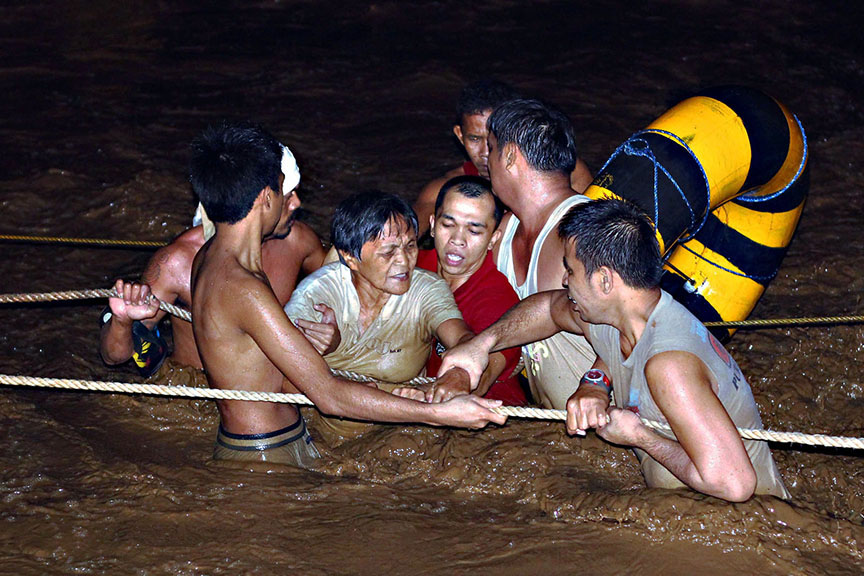
After Typhoon Sendong pummeled our home in Consolacion in 2011, I found it incredibly difficult to write again. The trauma left me diagnosed with clinical depression and reliant on medication. Yet, by 2012, I found myself standing on the banks of the Iponan River, documenting the gold mining barges and environmental neglect. Through it all, Ma’am Carol somehow managed to encourage me to finally write about the experience for the super typhoon’s first anniversary.
I didn’t know then that these stories would later return to haunt me.
When I wrote about the “days of darkness” in Cagayan de Oro for the anniversary of Martial Law in 2015, I wasn’t just recording history. I was listening to men like Ka Jerry Orcullo recount the “flat iron” treatment — a block of ice pressed against a bare chest until the mind broke. Re-reading those lines now, I feel the weight of that silence again.
There is a specific kind of chill that comes from reading your own words from a decade ago and realizing they were prophetic.
Somewhere in the MindaNews archives, buried under the digital dust of twenty-plus years, lies a story where the phrase “New Vietnam” was used to describe the trajectory of Cagayan de Oro and Northern Mindanao. At the time, it felt like a bold warning from the ground.
Today, as the sirens of red-tagging and militarization blare louder than ever, it feels like a transcript of the present.
It was particularly memorable to me because then-EIC Carol Arguillas published my copy “as is.” It was a proud moment for me because I learned news writing by checking out the published version to see what the editor deleted, reworded, and paced my raw copy. That was how I learned about cadence, tone, syntax, and diction.
Writing for MindaNews allowed me to sit with those uncomfortable truths. I remember filing reports documenting the voices of activists and community leaders who saw the encroaching shadow of total war. They warned that if the state continued its fragmented, iron-fisted approach, our verdant hills would become a mess.

As Cong B. Corrales, I didn’t just report on the “New Vietnam” rhetoric; I became part of the story’s fallout. The same climate of suspicion that triggered those warnings in the past eventually turned its sights on the messengers.
My transition from the reporter who wrote about the days of darkness to the associate editor being labeled a “Kumander” on a tarpaulin in front of the Press Freedom Monument is the ultimate irony.
In 2023, I found myself no longer just the observer, but the subject — filing complaints against tech giants for the very harassment my reporting had triggered.
The “New Vietnam” wasn’t just a headline; it was a cycle. As I look back through my MindaNews bylines, I see that I wasn’t just writing the first draft of history — I was writing a warning that the world chose to skim rather than read.
Today, the Cong B. Corrales of those early archives feels like a stranger.
He was more urgent, perhaps more aggressive. The man writing today is calmer and strategic, I suppose, marked by decades of witnessing.
The byline remains the same, but the man behind it has been rewritten by Mindanao itself, with the first push of MindaNews.
(Leonardo Vicente “Cong” Corrales has worked as a freelance news correspondent since 2008. He has written news, investigative, and feature articles for MindaNews, was a news correspondent for ABC TV5’s news web portal www.interaksyon.com, news stringer for Inquirer.net and Philippine Daily Inquirer, Rights Report Philippines, Rappler, Gulf News, and Union of Catholic Asian News. He recently completed a six-year tenure as the editor-in-chief of Mindanao Gold Star Daily.
He has done in-depth reports on government spending, agrarian reform, peace and dialogue initiatives, environment, and socio-economics.)

No comments:
Post a Comment