

Bangsamoro peace process merits less than a minute in Marcos’ 86-minute SONA

DAVAO CITY (MindaNews / 27 July 2026) – The Bangsamoro peace process merited only three short paragraphs in President Ferdinand Marcos’ 5th State of the Nation Address (SONA) on Monday, delivered in 40 seconds on the 80th minute of his 86-minute speech, and focused primarily on the September 14 polls.
“In accordance with the Republic Act No. 12317, the BARMM electorate is now poised to partake in BARMM’s first regular parliamentary election. This is a critical accomplishment under the Comprehensive Agreement on the Bangsamoro” (CAB), Marcos said, referring to the peace agreement the Philippine government signed with the Moro Islamic Liberation Front (MILF) on March 27, 2014.
“Comelec, law enforcement, volunteers, deputized agencies, all stakeholders are now ready to ensure that this defining political exercise will be peaceful, orderly, and credible,” he said, adding he hopes these “inspiring developments strengthen our collective belief in the unity and indivisibility of the Filipino nation amidst our individual diversity.”
The Bangsamoro peace process, however, does not end with the elections.

The peace agreement provides that at the end of the transition period, the government and MILF peace panels, the Malaysian facilitator and the Third Party Monitoring Team (TPMT) that the two parties created, are supposed to meet to review, assess or evaluate the implementation of all agreements and the progress of the transition. An “exit document” officially terminating the peace negotiation may be crafted and signed by both parties “if and only when all agreements have been fully implemented.”
The thrice-extended transition period ends on October 30, 2026, on the same day the 80 newly-elected Members of Parliament, assume their posts.
Political and Normalization tracks
The implementation of the CAB, contained in Republic Act 11054, has two tracks – the political track and the normalization track.
Miriam Coronel-Ferrer, chair of the government peace panel that signed the CAB along with MILF chair Mohagher Iqbal in 2014, noted that there are two tracks to the Bangsamoro peace process: the governance aspect revolving around the BARMM government as the main vehicle, and the normalization component where the government and MILF Peace Implementing Panels (PIP) are the main mechanism.
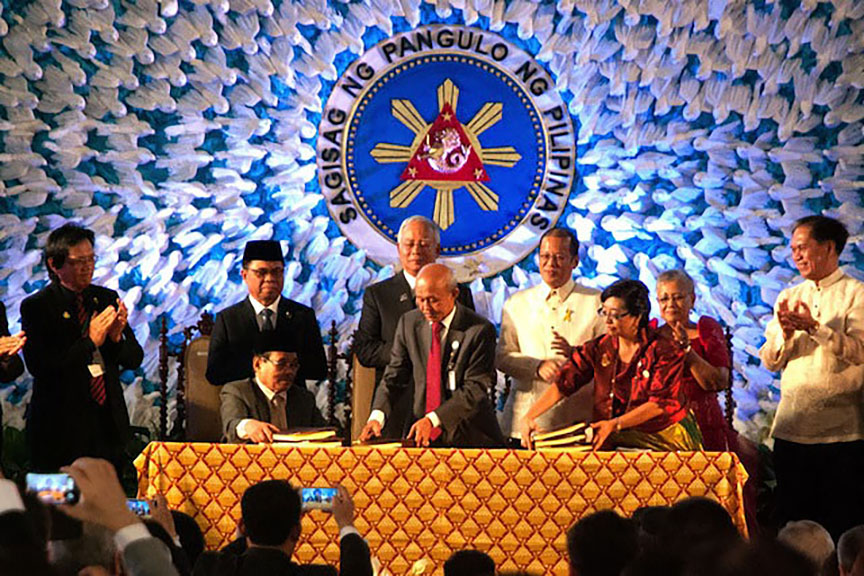
“The SONA reflected the current drift where the BARMM mechanism led by national government appointees are unduly privileged at the expense of the PIP. The symbolic manifestations of this unevenness is the absence of the MILF chair and PIP in the event, and the one-time mention of the CAB in relation to the upcoming election where the government-backed party is being promoted, but silence on the MILF in relation the normalization aspects of the CAB,” she told MindaNews Monday night.
“If the President is being made to believe that the election is the only remaining aspect of the CAB’s implementation, he is getting it all wrong,” Ferrer said.
“Level the political playing field”
Iqbal, MILF Peace Implementing Panel chair, told MindaNews Monday night that the conduct of the BARMM election “is just one of the indicators of the journey to peace.”
“How about the other deliverables under the normalization process?” Iqbal asked.
He also express concern “about the obvious support of men in the government for the BFP, referring to the Bangsamoro Federalist Party. “Even the name of the party has an unmistakable semblance with the president’s own party, Partido Federal Ng Pilipinas,” he said.
He appealed to the President to “level the political playing field in order to have a fair, credible, and peaceful election in September 2026. This will help raise or restore the trust and confidence between the parties,” he said.

“Marcos mentioned the BARMM elections after echoing the ASEAN’s call for an end to violent conflict in other parts of the world.
“We appeal to all parties for a heightened sense of community, to a return to the table, armed only with a genuine desire for peace and for normalcy. True diplomacy builds,” he said, adding that “violent conflict only destroys.”
“Peace and order are the foundations of security for our country, for our region, for the world,” he said.
Shifting his focus to the Philippines, Marcos said government is ready to formalize a historic completion of the government’s peace pact with the CBA-CPLA (Cordillera Bodong Administration-Cordillera People’s Liberation Army) after “a long but worthwhile 15 years since its signing.”
He then proceeded to talk about the BARMM elections.
All factions represented
Formal peace negotiations between the Philippine government (GPH) and MILF spanned four administrations (Ramos, Estrada, Arroyo, Benigno Aquino III) although there were attempts under the post-EDSA administration of Corazon Aquino.
Implementation of the peace agreement signed under the Aquino administration in 2014 has spanned three administrations – Aquino, Duterte and Marcos Jr.
The MILF broke away from the Moro National Liberation Front (MNLF) led by Nur Misuari in the late 1970s after the failed implementation of the 1976 Tripoli Agreement under the administration of Ferdinand Marcos Sr.
President Corazon Aquino (1986 to 1992) resumed peace negotiations with the MNLF but no agreement was reached until the Ramos administration (1992 to 1998) signed a Final Peace Agreement (FPA) with the MNLF on September 2, 1996.
The implementation of the FPA also faced several challenges that eventually led to the division of the MNLF into the Misuari faction and the MNLF Executive Council of 15 or what would be later referred to as Sema-Jikiri faction.
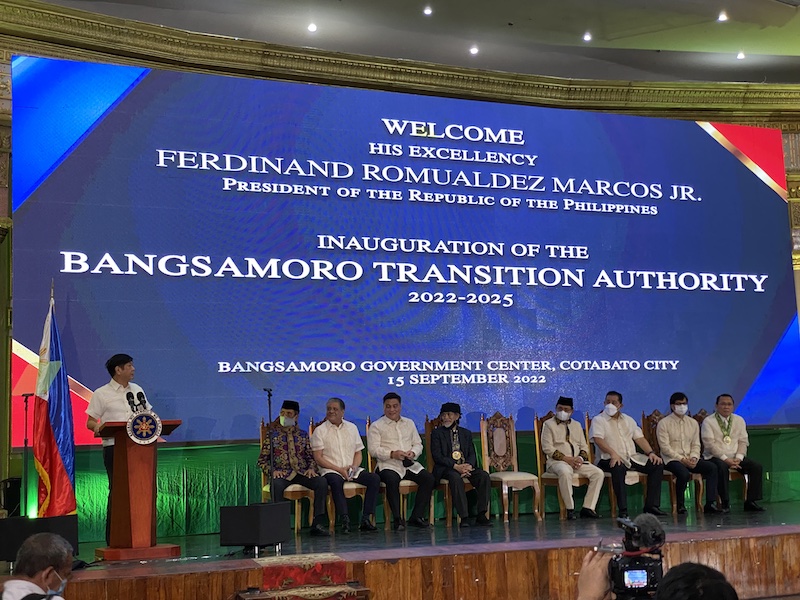
Misuari’s MNLF was invited to nominate members for appointment to the MILF-led Bangsamoro Transition Commission (BTC) under the Aquino administration but Misuari sent no names. When Rodrigo Duterte took over as President and named members of the expanded BTC in 2017 and by 2019, the Bangsamoro Transition Authority (BTA), the 80-member appointed body tasked to govern the BARMM during the transition period, the MNLF-Misuari did not also submit names of nominees.
It was only under the administration of Marcos Jr. when all the Moro Liberation fronts were finally represented in the BTA which held its inaugural session under the Marcos Jr. administration on September 15, 2022 – because the MNLF-Misuari finally agreed to nominating members to the BTA.
Split
The MILF-led BTA then was chaired by Ahod “Al Haj Murad” Ebrahim, with 55 representatives from all the Moro liberation fronts: 41 from the MILF, seven from the MNLF Sema-Jikiri and seven from the MNLF-Nur Misuari, including two of his children—Abdulkarim and Nurredha.
In March last year, Marcos replaced Ebrahim as the interim Chief Minister with Abdulraof Macacua, also of the MILF and at that time chief of the MILF’s Bangsamoro Islamic Armed Forces. Several nominees of the MILF were not reappointed.

The move eventually led to the division of the MILF with at least two major parties – United Bangsamoro Justice Party and Bangsamoro Federalist Party, both composed of MILF members and supporters – competing for Parliament seats.
Teresita Quintos-Deles, Presidential Adviser on the Peace Process when the CAB was signed, said the government’s commitment to an MILF-led transition was “seriously breached,” when Murad was replaced.
As a result, she said the MILF “has split into two, competing political parties – making the MILF’s post-elections role even more tenuous.”
“While some may prefer to regard this serious organizational break-up – the first under the leadership of Murad – as an internal problem of the MILF, on the ground, it is popularly perceived as having been orchestrated by the national government. Massive rallies have been held both in Cotabato and in Manila in this regard, with effigies of government peace officials having been publicly mocked, for the first time ever,” she said.
GPH Peace Implementing Panel
In July last year, the MILF suspended the decommissioning process until there is “substantial compliance” by the national government in the other tracks of normalization, such as the provision of socio-economic package to the 26,145 decommissioned combatants.
In mid-March this year, MILF chair Murad declared a “temporary pause” in their engagements in the Bangsamoro peace process until a “full-fledged chairman” of the government peace implementing panel is named.
On April 21, Marcos appointed Mel Senen Sarmiento, a former Local Governments Secretary under the Aquino administration, as the new Presidential Adviser on Peace, Reconciliation and Unity, vice Carlito Galvez who resigned citing health reasons.
But it would three months for Marcos to name a GPH Peace Implementing Panel chair. He named Sarmiento as concurrent GPH PIP chair on July 15. Sarmiento immediately met with officials of the government’s peace mechanisms and vowed to meet with his counterparts in the MILF “at the soonest possible time.

The MILF welcomed Sarmiento’s appointment. Iqbal described Sarmiento as an “excellent choice.”
Beginning and end
The transition period should have ended on June 30, 2022 but was extended to June 30, 2025, extended again until October 30, 2025 and finally until October 30, 2026.
October 30, 2026, the day the newly-elected officials assume their posts, also marks the end of the transition period.
Bangsamoro voters will elect 40 political party representatives, 32 single district representatives and eight sectoral representatives.
The 80 elected Members of Parliament elect the Chief Minister.
Monday’s SONA was Marcos’ fifth. It would have been the last SONA where he could have reported to the nation that the transition period was ending in three months, and what other aspects of the Bangsamoro peace process need to be attended to in the next three months and in the remaining two years of his administration.
Earlier in his speech, Marcos BARMM in relation to energy contracts.
He said 14 petroleum service contracts have been awarded in Luzon, Visayas and Mindanao, Two of these contracts “are co-managed with BARMM Government.”
“This is the first time in our political history. BARMM is now firmly set to pursue its strategic vision of energy security and total electrification for and in the Bangsamoro region.” (Carolyn O. Arguillas /MindaNews)

No comments:
Post a Comment